Volume 14, Issue 1 (1-2025)
J Community Health Res. 2025, 14(1): 25-35 |
Back to browse issues page


Download citation:
BibTeX | RIS | EndNote | Medlars | ProCite | Reference Manager | RefWorks
Send citation to:


BibTeX | RIS | EndNote | Medlars | ProCite | Reference Manager | RefWorks
Send citation to:
Owlia F, Hakimian R. COVID-19 Related Challenges in Virtual Dental Education: Dental Students Experience. J Community Health Res. 2025; 14 (1) :25-35
URL: http://jhr.ssu.ac.ir/article-1-1080-en.html
URL: http://jhr.ssu.ac.ir/article-1-1080-en.html

1- Department of Oral and Maxillofacial Medicine, School of Dentistry, Shahid Sadoughi University of Medical Sciences and Health Services, Yazd, Iran
2- Library and Information Center, School of Dentistry, Shahid Sadoughi University of Medical Sciences and Health Services, Yazd, Iran ,hakimianr@yahoo.com
2- Library and Information Center, School of Dentistry, Shahid Sadoughi University of Medical Sciences and Health Services, Yazd, Iran ,
Full-Text [PDF 597 kb]
(633 Downloads)
| Abstract (HTML) (1536 Views)
How to cite this paper:
Owlia F, Hakimian R. COVID-19-Related Challenges in Virtual Dental Education: Dental Students Experience. J Community Health Research 2025; 14(1): 25-35.
Introduction
* T-test
** One Way ANOVA test
Discussion
Female students' participation in the present study was higher than that of male students. This disparity may be attributed to the decreasing number of male dental students in dental schools. There is limited evidence documenting the significant impact of this pandemic on higher education (19). One study has dedicated that COVID-19 pandemic had a positive impact on students’ practice (20).
The pandemic caused an abrupt and unprecedented shock to the educational system, making conventional teaching methods unviable. The authors were left with limited options and unconventional resources. Multidisciplinary approaches and clinical settings were abandoned. Online teaching, although rudimentary in many institutions, became the only solution. The teaching of medical clinical skills has become a significant challenge due to the lack of evident clinical implementation in online education (17).
E-learning methodology has certain disadvantages and is not an ideal platform for teaching practical fields such as dentistry (17). Conversely, the participants indicated that endodontic dentistry was the subspecialty most negatively impacted. This is understandable, as many students' clinical expectations in general dentistry focus on endodontic and restorative procedures. In the other study in Jordan, dental students experience more damage from conservative dentistry. In fact, education in basic sciences needs practice and ample clinical exposure.
Consequently, there was a noticeable variation in students' responses regarding courses affected by quarantine. These responses are only slightly distinguishable from those in the study that suggested conservative dentistry experienced the greatest damage (17). This study showed that dental public health, oral radiology, oral pathology, and orthodontics were the least affected. This finding is at variance with previous research (17). They stated the least educational damage was related to oral surgery, periodontics, orthodontics, and oral diagnosis. They believed increased confidence and competence may stem from the extensive clinical experience they gained in the previous academic year (17).
Growing evidence believes that E-learning is as effective as classic methods (21). Research evaluating the obstacles and advantages of distance education concluded that the repeatability of E-learning can enhance both learning and achievement (22). Some literature has shown that medical students are generally more satisfied with E-learning methods (23, 24). Despite the interactive nature of E-learning, the students seemed to prefer traditional lectures over online courses. This finding aligns with the research by Amir et al., which indicated that more students experienced lower learning satisfaction and encountered greater communication issues with instructors during online activities (13). The results of this study were inconsistent with the study in Taiwan which showed that approximately 366 (77%) of students had positive perceptions of online learning. The reason for this is that they had to become familiar with E-learning (18).
More than half of the students (63.4%) felt that online assessment is not a good evaluation method. This rate was close to the study done by Hatter et al. (17).
There were notable differences among the various grades. Fewer acceptances were reported in 4th grade, likely due to lower levels of social interaction. In later years, students have more opportunities to get to know each other and collaborate. A significant percentage of students (51.6%) believe that the quarantine improved their collaboration with peers, with no significant differences based on gender. A similar study affirmed that they collaborated with their classmates more (51.9%) (17).
The role of academic teachers is to motivate students to remain engaged throughout their education (1).
Students should receive clear guidance when making decisions that will significantly impact their education (25).
Nearly one-third of students were consistently fully present in class once they transitioned to online learning. More than two-third of students preferred to stay connected through video. This result significantly contrasts with the findings of Iurcove (2021), which reported that less than 10% of students preferred video connections in their study (9).
Before the pandemic, online courses and offline courses (pre-recorded courses) in dental education were not popular in Asia. (18). Pre-recorded courses also require more time to implement. It took considerable time for dental schools to prepare these courses (1).
In total, 77.5% of students were dissatisfied with the status of virtual education provided by the faculty. This percentage was similar to the percentage reported in Romania (67.3%) (9). Most of the students preferred face-to-face lectures compared to online ones. The majority of Jordanian dental students preferred to have a well-structured year of residence with proper training after graduation (17).These results highlight the significance of face-to-face classes. In this study, the fields of dentistry most affected by quarantine were clinical and pre-clinical courses (47.5%). Clinical training could not be entirely replaced by E-learning; therefore, it was essential to create a safe and supportive environment for hands-on learning. The results indicated that 55% of the students believed all subjects could be taught online, while 60% felt the same about dental professional courses that included a laboratory component. This figure contrasts sharply with Cheng's findings in Taiwan, where only 10.36% shared this belief (18).
The high preference for online laboratory courses in this study may stem from students' inability to fully observe all aspects of the demonstration process. Before online training, students should gathered around the teacher during demonstration process to see the dental cast. Therefore, blended learning or virtual reality education for laboratory courses was in priority. Blended learning is a combination of simultaneous E-learning and traditional learning (26). Students expressed similar levels of fear regarding the risk of contracting the virus from either classmates or patients during their internships. However, the average level of reported fear of COVID-19 infection differed from that observed in a similar study (9). Iurcov et al. stated that the highest level of fear of COVID-19 infection belonged to doing dental practice for patients (9). Dental students in 4th grade, who showed a significant difference, had the lowest scores regarding both intentions to engage in online activities. It is essential to implement personal protective measures to the highest standards. Over half of the students (64.1%) in the present study felt that their practical education was at risk due to the quarantine. This finding aligned perfectly with the results of the previous study (70%) (17).
The analysis of the responses revealed that online participation did not help individuals organize their daily schedules more effectively. However, 29.2% of participants reported being able to focus better on new information received during online courses compared to traditional classes. This finding contradicts previous research in this area (9). In that study, 45.9% of students declared online activities motivated them to better organize their daily schedule.(9). In their work, all of the classes were held online, while most of classes in this work were pre-recorded. The failure of distant learning relies on the loss of students’ motivation and a lack of virtual interaction between learners and facilitators (29).
The participants of this study (51.6%) have pointed out that quarantine raised their collaboration and interactions, especially with their classmates. This was in good agreement with Hatter et al (17). Theur students did not appreciate the group discussion and clinical scenario. In addition, they had no more interest in distance learning compared to before.
It is important to note that online learning is closely tied to information technologies. In response to the challenges posed by the recent pandemic, academic staff sought the necessary training to implement distance learning. As students are generally more familiar with technology, they are adapt more quickly than their senior teachers (25).
The value of learning computer science became evident to academics during the COVID-19 pandemic. It highlighted the importance of enhancing computer science skills, not only for dental students but also for educators, to improve the use of information technology in medical education institutions (30). Execution of training of teaching staff in charge of online learning is also crucial in stimulating students’ alertness (31). Because of 51.7% of students, teachers were well trained to use online operating system software and audio and video tools.
No significant difference was found between the two genders in all questions. This was in good agreement with previous research (17). This finding runs counter to Iurcov et al.’s study (9). In their study, a significant difference between women and men with online activity was reported, and men had more positive attitudes than women (9). As far as the experience of the authors is concerned, this issue is related to masculine temperament in female students. Finally, in addition to the negative consequences, the positive aspects of E-learning should be considered by academic teachers to ameliorate the quality of teaching and ensure the adequacy of vocational training for dentistry students. The infrastructure for dental education in the virtual environment needs to be strengthened so that, in case of need, theoretical and practical classes can be held with minimal issues
Limitations
The authors declare a note of caution concerning these findings. The results may be considered as a continuation of the research as a journey (9, 17, 18). Clear limitations, such as the fact that this was a cross-sectional study done at only one dental school, cannot be ignored. The generalizability of the results in this study is limited. Given the sample size, however, caution must be exercised. To view the whole picture of the impact of more dental students from different dental schools, future wider perspective survey studies appear essential. Novel strategies such as virtual reality systems could be a good substitute for solving this problem.
Conclusion
Within the limitation of this study, it is concluded that online activity could be a good substitute for dental students during the pandemic restrictions. Clinical and preclinical courses especially endodontics were the most affected field of dentistry.
Fear of COVID-19 infection was significantly correlated with the positive correlation evident for online activity.
Acknowledgment
This study has been supported financially by the Vice Chancellor for Research and Technology of Yazd Shahid Sadoughi University of Medical Sciences.
Conflicts of interest
The authors declared no conflict of interests.
Funding
The present study was supported by the Vice-Chancellor of Research and Technology, Yazd Shahid Sadoughi University of Medical Sciences.
Ethical considerations
Data were collected after obtaining written informed consent from all of the participants. This research project was approved by the Ethics Committee of Yazd Shahid Sadoughi University of Medical Sciences, Yazd, Iran.
Code of ethical
IR.SSU.DENTISTRY. REC.1400.021
Authors’ contributions
F. O, designed the study and wrote the manuscript; R. H, gathered data, cooperated in manuscript preparation and submitted it. Both authors analyzed the data and cooperated in revising the manuscript.
Open access policy
JCHR does not charge readers and their institutions for access to its papers. Full-text downloads of all new and archived papers are free of charge.
References
1. Farrokhi F, Mohebbi SZ, Farrokhi F, et al. Impact of COVID-19 on dental education- a scoping review. BMC Med Educ. 2021; 21(1): 587. [Persian]
2. Owlia F, Kargar M-J, Kazemipoor M. Investigating the pre- and post-COVID-19 vaccination infection status of Iranian dental students: a cross-sectional study. The Egyptian Journal of Bronchology. 2025; 19(1): 5. [Persian]
3. Cucinotta D, Vanelli M. WHO Declares COVID-19 a Pandemic. Acta Biomed. 2020; 91(1): 157-160.
4. El Keshky MES, Basyouni SS, Al Sabban AM. Getting Through COVID-19: The Pandemic’s Impact on the Psychology of Sustainability, Quality of Life, and the Global Economy – A Systematic Review. Frontiers in Psychology. 2020; 11.
5. Hajimaghsoodi S, Paydar E, Owlia F. Determination of objective taste perception among Iranian medical sciences students during COVID-19 pandemic in Yazd, Eastern Iran: a case-control pilot study. BMC Infectious Diseases. 2024; 24(1): 997. [Persian]
6. Misra M, Joshi H, Sarwal R, et al. Exit strategies from lockdowns due to COVID-19: a scoping review. BMC Public Health. 2022; 22(1): 488.
7. Chu DK, Akl EA, Duda S, et al. Physical distancing, face masks, and eye protection to prevent person-to-person transmission of SARS-CoV-2 and COVID-19: a systematic review and meta-analysis. Lancet. 2020; 395(10242): 1973-1987.
8. Karimian Z, Farrokhi MR, Moghadami M, et al. Medical education and COVID-19 pandemic: a crisis management model towards an evolutionary pathway. Educ Inf Technol (Dordr). 2021: 1-22. [Persian]
9. Iurcov R, Pop LM, Iorga M. Impact of COVID-19 Pandemic on Academic Activity and Health Status among Romanian Medical Dentistry Students; A Cross-Sectional Study. Int J Environ Res Public Health. 2021; 18(11).
10. Oyedotun TD. Sudden change of pedagogy in education driven by COVID-19: Perspectives and evaluation from a developing country. Research in Globalization. 2020; 2: 100029.
11. Razmara F, Khayamzadeh M, Shabankare G. Dental practice in the era of COVID-19: A review of literature. J Family Med Prim Care. 2021; 10(1): 41-47. [Persian]
12. Zheng M, Bender D, Lyon C. Online learning during COVID-19 produced equivalent or better student course performance as compared with pre-pandemic: empirical evidence from a school-wide comparative study. BMC Medical Education. 2021; 21(1): 495.
13. Amir LR, Tanti I, Maharani DA, et al. Student perspective of classroom and distance learning during COVID-19 pandemic in the undergraduate dental study program Universitas Indonesia. BMC Medical Education. 2020; 20(1): 392.
14. Soltanimehr E, Bahrampour E, Imani MM, et al. Effect of virtual versus traditional education on theoretical knowledge and reporting skills of dental students in radiographic interpretation of bony lesions of the jaw. BMC Medical Education. 2019; 19(1): 233. [Persian]
15. Borhani F, Vatanparast M, Zadeh AA, et al. Virtual education effect on cognitive learning and attitude of nursing students towards it. Iran J Nurs Midwifery Res. 2011; 16(4): 321-4. [Persian]
16. Padhi KS, Balmuchu G, Acharya PS, et al. The Perspectives of Educators and Learners on E-Learning: A Cross-Sectional Descriptive Study in a Medical School. Adv Med Educ Pract. 2021; 12: 1059-1066.
17. Hattar S, AlHadidi A, Sawair FA, et al. Impact of COVID-19 pandemic on dental education: online experience and practice expectations among dental students at the University of Jordan. BMC Med Educ. 2021; 21(1): 151.
18. Cheng HC, Lu SL, Yen YC, et al. Dental education changed by COVID-19: Student's perceptions and attitudes. BMC Med Educ. 2021; 21(1): 364.
19. Romeo M, Yepes-Baldó M, Soria MÁ, et al. Impact of the COVID-19 Pandemic on Higher Education: Characterizing the Psychosocial Context of the Positive and Negative Affective States Using Classification and Regression Trees. Frontiers in Psychology. 2021; 12.
20. Gonzalez T, de la Rubia MA, Hincz KP, et al. Influence of COVID-19 confinement on students' performance in higher education. PLoS One. 2020; 15(10): e0239490.
21. Schlenz MA, Schmidt A, Wöstmann B, et al. Students’ and lecturers’ perspective on the implementation of online learning in dental education due to SARS-CoV-2 (COVID-19): a cross-sectional study. BMC Medical Education. 2020; 20(1): 354.
22. Regmi K, Jones L. A systematic review of the factors – enablers and barriers – affecting e-learning in health sciences education. BMC Medical Education. 2020; 20(1): 91.
23. Huynh R. The Role of E-Learning in Medical Education. Acad Med. 2017; 92(4): 430.
24. Ruiz JG, Mintzer MJ, Leipzig RM. The impact of E-learning in medical education. Acad Med. 2006; 81(3): 207-12.
25. Chang TY, Hong G, Paganelli C, et al. Innovation of dental education during COVID-19 pandemic. J Dent Sci. 2021; 16(1): 15-20.
26. Chang T-Y, Hsu M-L, Kwon J-S, et al. Effect of online learning for dental education in asia during the pandemic of COVID-19. Journal of Dental Sciences. 2021; 16(4): 1095-1101.
27. Kelekar AK, Lucia VC, Afonso NM, et al. COVID-19 vaccine acceptance and hesitancy among dental and medical students. J Am Dent Assoc. 2021; 152(8): 596-603.
28. Conway DI, Culshaw S, Edwards M, et al. SARS-CoV-2 Positivity in Asymptomatic-Screened Dental Patients. J Dent Res. 2021; 100(6): 583-590.
29. Pelikan ER, Lüftenegger M, Holzer J, et al. Learning during COVID-19: the role of self-regulated learning, motivation, and procrastination for perceived competence. Zeitschrift für Erziehungswissenschaft. 2021; 24(2): 393-418.
30. Ghanbari N, Nowroozi S. The practice of online assessment in an EFL context amidst COVID-19 pandemic: views from teachers. Language Testing in Asia. 2021; 11(1): 27. [Persian]
31. Rapanta C, Botturi L, Goodyear P, et al. Online University Teaching During and After the Covid-19 Crisis: Refocusing Teacher Presence and Learning Activity. Postdigital Science and Education. 2020; 2(3): 923-945.
Full-Text: (156 Views)
| COVID-19 Related Challenges in Virtual Dental Education: Dental Students Experience |

- Department of Oral and Maxillofacial Medicine, School of Dentistry, Shahid Sadoughi University of Medical Sciences and Health Services, Yazd, Iran
- Library and Information Center, School of Dentistry, Shahid Sadoughi University of Medical Sciences and Health Services, Yazd, Iran
| ARTICLE INFO | ABSTRACT | |
| Original Article Received: 26 Dec 2024 Accepted: 03 Mar 2025 |
Background: Dental students have experienced changes in their learning format due to the SARS-CoV-2 pandemic. This study aimed to evaluate their perspectives on E-learning during this time. Methods: A cross-sectional study utilizing a validated and reliable questionnaire and an online self-report was conducted with dental students in 2022 in Yazd. The study included 120 dental students from the last three years of their program. Socio-demographic and academic data were collected, and certain questions explored students' perspectives on E-learning and its impact on dental education during the COVID-19 pandemic. Responses were rated using a four-point Likert-like scale. Data analysis was performed using SPSS (v. 24) with paired T-tests, one-way ANOVA, Tukey tests, and Pearson correlation (P < 0.05). Results: There was an insignificant difference between the two genders across all dimensions. Overall, 39 students (32.5%) believed that online courses are more appealing than in-person classes, whereas 72 students (60%) found dental professional courses with a laboratory format more engaging than online courses. A significant difference in the fear of COVID-19 was noted among 5thyear students compared to 4thyear and 6thyear students (P-value = 0.0001). Endodontics (39.2%) and prosthodontics (30.8%) were the two fields that were most negatively affected. Conclusions: The results of this study indicated that online activity could serve as a beneficial substitute for dental students during the quarantine. Overall, students expressed positive views about the impact of E-learning during the COVID-19 pandemic. Additionally, a significant correlation was found between the fear of COVID-19 infection and the positive experiences associated with online activity. Keywords: Coronavirus disease, COVID-19, dental education, perception |
|
 |
||
Corresponding Author: Roqayeh Hakimian hakimianr@yahoo.com |
Owlia F, Hakimian R. COVID-19-Related Challenges in Virtual Dental Education: Dental Students Experience. J Community Health Research 2025; 14(1): 25-35.
Introduction
Coronavirus disease 2019 (COVID-19) is a global infectious disease caused by the severe acute respiratory syndrome coronavirus 2
(SARS-CoV-2) (1). The ongoing COVID-19 pandemic has resulted in extensive infection and mortality, profoundly affecting both medical and dental education and treatment practices. Dental professionals, in particular, are regarded as a
high-risk group for contracting and transmitting the virus (2). The COVID-19 pandemic is a highly infectious disease that has significantly impacted health, disrupted social activities, and affected economies worldwide (4). Some side effects of COVID-19 remained after a recovery period. Even after recovering from COVID-19, some individuals report lingering symptoms, such as a persistent loss of their sense of smell and taste (5).
Nations have implemented various containment measures to slow the spread of the virus that causes COVID-19. Lockdowns, isolation, contact tracing, and social distancing have significantly impacted the world both socially and economically (6).
Findings from a recent systematic review and meta-analysis support maintaining a distance of one meter or more in social interactions and wearing face masks and eye protection (7). Inevitably, face-to-face education was replaced with virtual education (8).
Moreover, dental education in both preclinical laboratories and clinics was impacted by the COVID-19 pandemic (9).
Educators also scrambled to adapt to physical distancing measures and self-quarantine protocols (10).
In addition, dental professionals faced a higher risk of infection patients due to the nature of dentistry practice. Their practice involves face-to-face communication, along with frequent exposure to blood, saliva, droplets, and aerosols (11). As a result, many dental schools worldwide have adopted virtual modes of online and offline courses. However, numerous challenges have emerged from these measures that will have lasting effects. These challenges are particularly concerning because dental students are more susceptible to infections, including COVID-19, due to insufficient infection protection (12). Facing an unprecedented period in the global dental education system, we have a valuable opportunity to share novel experiences, learn, and grow. While virtual courses are generally viewed as offering safety benefits for dental students, students' perspectives on these courses may not be as positive as anticipated. Additionally, it is important to enhance our knowledge about COVID-19 (13).
Despite these new adaptations aimed at educational matters, there is limited evidence on the actual impact of virtual education on knowledge retention (14, 15).
While studies have highlighted successful experiences in isolated dental specialties, options for preclinical and clinical training remain limited (14).
Due to the crisis, there was a strong demand for the widespread adoption of technology in learning and teaching. During the pandemic, various tools for E-learning were utilized, including prerecorded lecture PowerPoints and online education platforms (16).
To the authors’ knowledge, few studies have evaluated the viewpoint of dental students toward modifications of dental education during pandemic COVID-19 (9, 17).
Understanding these perceptions can help policymakers and authorized university staff design and enhance dental education. This study aims to explore the views of Iranian dental students regarding online courses during the COVID-19 pandemic.
Methods
Study sample
During the COVID-19 pandemic, a cross-sectional study was conducted at Yazd, dental faculty in February 2022. Inclusion criteria consisted of students from 4th to 6th grades who were randomly chosen to participate in the study. The randomized method was selected for sampling by packed enveloped pockets. The study form was sent to 135 students who were chosen for the study via social media. Then, the questionnaire was distributed using the Porsline platform. A reminder was sent to the participants after one week and one month to fill out the questionnaire.
The sample size was calculated to be 120, using the following formula for estimating the mean score considering P = 49%, d = 13%, and type one error = 0.05.

A total of 120 participants answered the questionnaire, and the names and other personal information of the participants were protected. The entire questionnaire’s design obligated the participants to answer all the questions to ensure the returned electronic forms were complete. Uncompleted questionnaires were excluded.
Questionnaire
The study instrument used was a self-administered questionnaire.
The questionnaire was crafted by a team of Oral and Maxillofacial Medicine specialists who validated its accuracy and dependability. Both its validity and reliability were confirmed. A combined Cronbach's alpha value for all subscales approximated 0.71. Also, a pilot study was conducted to assess the questionnaire's reliability further. Additionally, the questionnaire was pretested with 13 randomly chosen participants, leading to a consensus on the clarity and pertinence of all questions. Subsequently, the questionnaire was disseminated via the Porsline platform.
The anonymous questionnaire contained 22 items in three major categories: demographic information, viewpoint toward E-learning, the impact of COVID-19, and fear of COVID-19 infection (3 items). It is composed of 28 structured questions and 2 open questions regarding the fact that which field of dental education was more disturbed by E-learning. The respondents indicated their level of agreement with the statements using a four-item Likert-type scale rated as follows: 1-strongly disagree, 2-disagree, 3-agree, and 4-strongly agree. The questionnaire was designed and validated the contents by the expert panel. The experts conducted their review independently.
Statistical analysis
Categorical variables were summarized as counts (percentage). T-test, one-way ANOVA, Tukey test, and Pearson correlation were used in this study. All statistical analyses were performed with SPSS 24. The statistical significance level was determined at p < 0.05.
Results
Overall, the results presented below show that a total of 120 participants responded to the questionnaire, yielding a response rate of 88.88%. From each grade year 4th, 5th, and 6th grade, 40 students participated. They were 66 (55%) female and 54 (45%) male students. The mean age ± SD of patients was 24.54 ± 2.49 ranging from 22-35. The mean and standard deviation of dentistry students’ viewpoints regarding demographic distribution are presented in Table 1.
The mean score of viewpoints on E-learning was 2.79 ± 0.66 out of 4 points. The average scores of viewpoints in different dimensions are displayed in Table 1.
The results of the T-test indicated that there was no statistically significant difference between the viewpoints of the two genders (P-value > 0.05). The results of the one-way ANOVA test illustrated that there was a statistically significant difference among the mean scores of
students' viewpoints in the 4th, 5th, and 6th grade (P-value > 0.05) (Table 1).
(SARS-CoV-2) (1). The ongoing COVID-19 pandemic has resulted in extensive infection and mortality, profoundly affecting both medical and dental education and treatment practices. Dental professionals, in particular, are regarded as a
high-risk group for contracting and transmitting the virus (2). The COVID-19 pandemic is a highly infectious disease that has significantly impacted health, disrupted social activities, and affected economies worldwide (4). Some side effects of COVID-19 remained after a recovery period. Even after recovering from COVID-19, some individuals report lingering symptoms, such as a persistent loss of their sense of smell and taste (5).
Nations have implemented various containment measures to slow the spread of the virus that causes COVID-19. Lockdowns, isolation, contact tracing, and social distancing have significantly impacted the world both socially and economically (6).
Findings from a recent systematic review and meta-analysis support maintaining a distance of one meter or more in social interactions and wearing face masks and eye protection (7). Inevitably, face-to-face education was replaced with virtual education (8).
Moreover, dental education in both preclinical laboratories and clinics was impacted by the COVID-19 pandemic (9).
Educators also scrambled to adapt to physical distancing measures and self-quarantine protocols (10).
In addition, dental professionals faced a higher risk of infection patients due to the nature of dentistry practice. Their practice involves face-to-face communication, along with frequent exposure to blood, saliva, droplets, and aerosols (11). As a result, many dental schools worldwide have adopted virtual modes of online and offline courses. However, numerous challenges have emerged from these measures that will have lasting effects. These challenges are particularly concerning because dental students are more susceptible to infections, including COVID-19, due to insufficient infection protection (12). Facing an unprecedented period in the global dental education system, we have a valuable opportunity to share novel experiences, learn, and grow. While virtual courses are generally viewed as offering safety benefits for dental students, students' perspectives on these courses may not be as positive as anticipated. Additionally, it is important to enhance our knowledge about COVID-19 (13).
Despite these new adaptations aimed at educational matters, there is limited evidence on the actual impact of virtual education on knowledge retention (14, 15).
While studies have highlighted successful experiences in isolated dental specialties, options for preclinical and clinical training remain limited (14).
Due to the crisis, there was a strong demand for the widespread adoption of technology in learning and teaching. During the pandemic, various tools for E-learning were utilized, including prerecorded lecture PowerPoints and online education platforms (16).
To the authors’ knowledge, few studies have evaluated the viewpoint of dental students toward modifications of dental education during pandemic COVID-19 (9, 17).
Understanding these perceptions can help policymakers and authorized university staff design and enhance dental education. This study aims to explore the views of Iranian dental students regarding online courses during the COVID-19 pandemic.
Methods
Study sample
During the COVID-19 pandemic, a cross-sectional study was conducted at Yazd, dental faculty in February 2022. Inclusion criteria consisted of students from 4th to 6th grades who were randomly chosen to participate in the study. The randomized method was selected for sampling by packed enveloped pockets. The study form was sent to 135 students who were chosen for the study via social media. Then, the questionnaire was distributed using the Porsline platform. A reminder was sent to the participants after one week and one month to fill out the questionnaire.
The sample size was calculated to be 120, using the following formula for estimating the mean score considering P = 49%, d = 13%, and type one error = 0.05.
A total of 120 participants answered the questionnaire, and the names and other personal information of the participants were protected. The entire questionnaire’s design obligated the participants to answer all the questions to ensure the returned electronic forms were complete. Uncompleted questionnaires were excluded.
Questionnaire
The study instrument used was a self-administered questionnaire.
The questionnaire was crafted by a team of Oral and Maxillofacial Medicine specialists who validated its accuracy and dependability. Both its validity and reliability were confirmed. A combined Cronbach's alpha value for all subscales approximated 0.71. Also, a pilot study was conducted to assess the questionnaire's reliability further. Additionally, the questionnaire was pretested with 13 randomly chosen participants, leading to a consensus on the clarity and pertinence of all questions. Subsequently, the questionnaire was disseminated via the Porsline platform.
The anonymous questionnaire contained 22 items in three major categories: demographic information, viewpoint toward E-learning, the impact of COVID-19, and fear of COVID-19 infection (3 items). It is composed of 28 structured questions and 2 open questions regarding the fact that which field of dental education was more disturbed by E-learning. The respondents indicated their level of agreement with the statements using a four-item Likert-type scale rated as follows: 1-strongly disagree, 2-disagree, 3-agree, and 4-strongly agree. The questionnaire was designed and validated the contents by the expert panel. The experts conducted their review independently.
Statistical analysis
Categorical variables were summarized as counts (percentage). T-test, one-way ANOVA, Tukey test, and Pearson correlation were used in this study. All statistical analyses were performed with SPSS 24. The statistical significance level was determined at p < 0.05.
Results
Overall, the results presented below show that a total of 120 participants responded to the questionnaire, yielding a response rate of 88.88%. From each grade year 4th, 5th, and 6th grade, 40 students participated. They were 66 (55%) female and 54 (45%) male students. The mean age ± SD of patients was 24.54 ± 2.49 ranging from 22-35. The mean and standard deviation of dentistry students’ viewpoints regarding demographic distribution are presented in Table 1.
The mean score of viewpoints on E-learning was 2.79 ± 0.66 out of 4 points. The average scores of viewpoints in different dimensions are displayed in Table 1.
The results of the T-test indicated that there was no statistically significant difference between the viewpoints of the two genders (P-value > 0.05). The results of the one-way ANOVA test illustrated that there was a statistically significant difference among the mean scores of
students' viewpoints in the 4th, 5th, and 6th grade (P-value > 0.05) (Table 1).
Table 1. Mean and standard deviation of dentistry students’ viewpoints regarding demographic distribution
| Dimensions | Variables | Mean | P-value |
| Online activity | Sex Male |
2.79 ± 0.0.64 |
*0.748 |
| Female | 2.75 ± 0.73 | ||
| Total | 2.77 ± 0.69 | ||
| Academic year 4 |
2.47 ± 0.64 |
**0.003 |
|
| 5 | 2.86 ± 0.65 | ||
| 6 | 2.96 ± 0.69 | ||
| Total | 2.77 ± 0.69 | ||
| Fear of COVID-19 infection | Sex Male |
2.87 ± 0.83 |
*0.385 |
| Female | 3.00 ± 0.78 | ||
| Total | 2.95 ± 0.80 | ||
| Academic year 4 |
2.53 ± 0.86 |
**0.0001 |
|
| 5 | 3.23 ± 0.63 | ||
| 6 | 3.08 ± 0.73 | ||
| Total | 2.95 ± 0.80 | ||
| Total viewpoint | Sex Male |
2.80 ± 0.62 |
*0.883 |
| Female | 2.78 ± 0.70 | ||
| Total | 2.79 ± 0.66 | ||
| Academic year 4 |
2.48 ± 0.62 |
**0.001 |
|
| 5 | 2.91 ± 0.61 | ||
| 6 | 2.98 ± 0.66 | ||
| Total | 2.79 ± 0.66 |
** One Way ANOVA test
The Tukey post hoc test showed a meaningful comparison of the viewpoints of the 4th year students with the 5th year students (P-value = 0.008) and 6th (P-value = 0.002) which was statistically significant, but this difference between 5th, and 6th-grade students was not statistically significant (P-value = 0.767). The findings from this test illustrated that there was a statistically significant difference in the field of online activity between 4th , 5th (P-value = 0.029) and 6th year students (P-value = 0.004). On the other hand, the difference between 4th students in the 5th (P-value = 0.0001) and 6th year (P-value = 0.004), in terms of the fear of COVID-19 was significant.
Intriguingly, fear of COVID-19 infection significantly Intriguingly, fear of COVID-19 infection significantly correlated with positive correlation with intention to online activity (P = 0.0001) (Pearson correlation coefficient 0.543). This means that as the fear of COVID-19 increased, so did the tendency to engage in online activities.
The relative frequency of students' responses to questions about online activity and fear of COVID-19 dimensions are displayed in Tables 2 and 3, respectively.
Intriguingly, fear of COVID-19 infection significantly Intriguingly, fear of COVID-19 infection significantly correlated with positive correlation with intention to online activity (P = 0.0001) (Pearson correlation coefficient 0.543). This means that as the fear of COVID-19 increased, so did the tendency to engage in online activities.
The relative frequency of students' responses to questions about online activity and fear of COVID-19 dimensions are displayed in Tables 2 and 3, respectively.
Table 2. Dentistry students’ opinions regarding online activity
| Items | Strongly agree n (%) |
Agree n (%) |
Disagree n (%) |
Strongly disagree n (%) |
M ± SD |
| I preferred the online activity over the one at the college | 16 (13.3) | 26 (21.7) | 32 (26.7) | 46 (38.3) | 2.90 ± 1.06 |
| Improving the organization of my daily schedule by incorporating online activities | 11 (9.2) | 30 (25) | 34 (28.3) | 45 (37.5) | 2.94 ± 0.99 |
| I believe all subjects should be taught online | 34 (28.3) | 32 (26.7) | 24 (20) | 30 (25) | 2.42 ± 1.15 |
| I want to connect through video during online activities | 24 (20) | 52 (43.3) | 29 (24.2) | 15 (12.5) | 2.29 ± 0.93 |
| The theoretical online courses were more appealing | 16 (13.3) | 23 (19.2) | 34 (28.3) | 47 (39.2) | 2.93 ± 1.06 |
| Clinical courses were more appealing | 29 (24.2) | 43 (35.8) | 33 (27.5) | 15 (12.5) | 2.28 ± 0.97 |
| Distance learning proceeded smoothly without any interruptions to the Internet connection | 8 (6.7) | 19 (15.8) | 48 (40) | 45 (37.5) | 3.08 ± 0.89 |
| Novel teaching methods in E-learning, such as scenarios and clinical cases, positively impacted my education. | 12 (10) | 19 (15.8) | 61 (50.8) | 28 (23.3) | 2.87 ± 0.88 |
| The training level of academic staff in using online platforms | 26 (21.7) | 36 (30) | 42 (35) | 16 (13.3) | 2.40 ± 0.97 |
| E-learning was conducted on a regular schedule | 9 (7.5) | 35 (29.2) | 56 (46.7) | 20 (16.7) | 2.72 ± 0.83 |
| I believe that the amount of time spent studying increased during quarantine | 11 (9.2) | 32 (26.7) | 40 (33.3) | 37 (30.8) | 2.86 ± 0.96 |
| During the pandemic, I had more time to dedicate to my hobbies | 10 (8.3) | 19 (15.8) | 54 (45) | 37 (30.8) | 2.98 ± 0.89 |
| Believing that online education is an effective method | 20 (16.7) | 23 (19.2) | 37 (30.8) | 40 (33.3) | 2.81 ± 1.08 |
| Teaching a large volume of information in online courses | 9 (7.5) | 26 (21.7) | 55 (45.8) | 30 (25) | 2.88 ± 0.87 |
| I did not miss any part of the course or lab during the connection | 10 (8.3) | 32 (26.7) | 43 (35.8) | 35 (29.2) | 2.86 ± 0.93 |
| The online activities provided me with an opportunity to focus better on new information | 12 (10) | 23 (19.2) | 51 (42.5) | 34 (28.3) | 2.89 ± 0.93 |
| Believing that online evaluation is an effective method of assessment | 17 (14.2) | 27 (22.5) | 44 (36.7) | 32 (26.7) | 2.76 ± 1.00 |
| This quarantine has enhanced my collaboration with my colleagues | 19 (15.8) | 43 (35.8) | 37 (30.8) | 21 (17.5) | 2.50 ± 0.96 |
Table 3. Items investigating the fear of COVID-19 infection
| Items | Strongly agree N (%) |
Agree N (%) |
Disagree N (%) |
Strongly disagree N (%) |
Mean ± SD |
| I was afraid of contracting COVID-19 from patients I had social interactions with. | 12 (10) | 31 (25.8) | 44 (36.7) | 33 (27.5) | 2.82 ± 0.95 |
| I was anxious about the possibility of contracting COVID-19 during my clinical courses at dental school | 13 (10.8) | 27 (22.5) | 45 (37.5) | 35 (29.2) | 2.85 ± 0.96 |
| I was afraid of contracting COVID-19 from my classmates at dental school | 9 (7.5) | 28 (23.3) | 51 (42.5) | 32 (26.7) | 2.88 ± 0.89 |
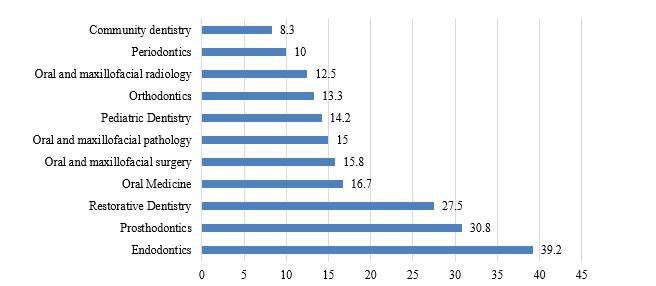
According to dental students’ opinions, the dental subspecialties most negatively affected by quarantine are shown in Figure 1. Endodontic (39.2%) followed by prosthodontics (30.8%) were the two most negatively affected subspecialties while community dentistry (8.3%) and periodontics (10%) were the two least negatively affected subspecialties.
Figure 1. Dental subspecialties most negatively affected by quarantine
Based on the dental students, viewpoints, the most affected areas due to this quarantine were reported in clinical and preclinical courses
(Table 4).
(Table 4).
Table 4. Frequency distribution of the most affected areas of quarantine
| dental education fields | Number (percent) |
| Clinical/preclinical courses | 57 (47.5) |
| Theory courses | 9 (7.5) |
| Group discussions and seminars | 10 (8.3) |
| None of them | 21 (17.5) |
| All of them | 23 (19.2) |
Discussion
Female students' participation in the present study was higher than that of male students. This disparity may be attributed to the decreasing number of male dental students in dental schools. There is limited evidence documenting the significant impact of this pandemic on higher education (19). One study has dedicated that COVID-19 pandemic had a positive impact on students’ practice (20).
The pandemic caused an abrupt and unprecedented shock to the educational system, making conventional teaching methods unviable. The authors were left with limited options and unconventional resources. Multidisciplinary approaches and clinical settings were abandoned. Online teaching, although rudimentary in many institutions, became the only solution. The teaching of medical clinical skills has become a significant challenge due to the lack of evident clinical implementation in online education (17).
E-learning methodology has certain disadvantages and is not an ideal platform for teaching practical fields such as dentistry (17). Conversely, the participants indicated that endodontic dentistry was the subspecialty most negatively impacted. This is understandable, as many students' clinical expectations in general dentistry focus on endodontic and restorative procedures. In the other study in Jordan, dental students experience more damage from conservative dentistry. In fact, education in basic sciences needs practice and ample clinical exposure.
Consequently, there was a noticeable variation in students' responses regarding courses affected by quarantine. These responses are only slightly distinguishable from those in the study that suggested conservative dentistry experienced the greatest damage (17). This study showed that dental public health, oral radiology, oral pathology, and orthodontics were the least affected. This finding is at variance with previous research (17). They stated the least educational damage was related to oral surgery, periodontics, orthodontics, and oral diagnosis. They believed increased confidence and competence may stem from the extensive clinical experience they gained in the previous academic year (17).
Growing evidence believes that E-learning is as effective as classic methods (21). Research evaluating the obstacles and advantages of distance education concluded that the repeatability of E-learning can enhance both learning and achievement (22). Some literature has shown that medical students are generally more satisfied with E-learning methods (23, 24). Despite the interactive nature of E-learning, the students seemed to prefer traditional lectures over online courses. This finding aligns with the research by Amir et al., which indicated that more students experienced lower learning satisfaction and encountered greater communication issues with instructors during online activities (13). The results of this study were inconsistent with the study in Taiwan which showed that approximately 366 (77%) of students had positive perceptions of online learning. The reason for this is that they had to become familiar with E-learning (18).
More than half of the students (63.4%) felt that online assessment is not a good evaluation method. This rate was close to the study done by Hatter et al. (17).
There were notable differences among the various grades. Fewer acceptances were reported in 4th grade, likely due to lower levels of social interaction. In later years, students have more opportunities to get to know each other and collaborate. A significant percentage of students (51.6%) believe that the quarantine improved their collaboration with peers, with no significant differences based on gender. A similar study affirmed that they collaborated with their classmates more (51.9%) (17).
The role of academic teachers is to motivate students to remain engaged throughout their education (1).
Students should receive clear guidance when making decisions that will significantly impact their education (25).
Nearly one-third of students were consistently fully present in class once they transitioned to online learning. More than two-third of students preferred to stay connected through video. This result significantly contrasts with the findings of Iurcove (2021), which reported that less than 10% of students preferred video connections in their study (9).
Before the pandemic, online courses and offline courses (pre-recorded courses) in dental education were not popular in Asia. (18). Pre-recorded courses also require more time to implement. It took considerable time for dental schools to prepare these courses (1).
In total, 77.5% of students were dissatisfied with the status of virtual education provided by the faculty. This percentage was similar to the percentage reported in Romania (67.3%) (9). Most of the students preferred face-to-face lectures compared to online ones. The majority of Jordanian dental students preferred to have a well-structured year of residence with proper training after graduation (17).These results highlight the significance of face-to-face classes. In this study, the fields of dentistry most affected by quarantine were clinical and pre-clinical courses (47.5%). Clinical training could not be entirely replaced by E-learning; therefore, it was essential to create a safe and supportive environment for hands-on learning. The results indicated that 55% of the students believed all subjects could be taught online, while 60% felt the same about dental professional courses that included a laboratory component. This figure contrasts sharply with Cheng's findings in Taiwan, where only 10.36% shared this belief (18).
The high preference for online laboratory courses in this study may stem from students' inability to fully observe all aspects of the demonstration process. Before online training, students should gathered around the teacher during demonstration process to see the dental cast. Therefore, blended learning or virtual reality education for laboratory courses was in priority. Blended learning is a combination of simultaneous E-learning and traditional learning (26). Students expressed similar levels of fear regarding the risk of contracting the virus from either classmates or patients during their internships. However, the average level of reported fear of COVID-19 infection differed from that observed in a similar study (9). Iurcov et al. stated that the highest level of fear of COVID-19 infection belonged to doing dental practice for patients (9). Dental students in 4th grade, who showed a significant difference, had the lowest scores regarding both intentions to engage in online activities. It is essential to implement personal protective measures to the highest standards. Over half of the students (64.1%) in the present study felt that their practical education was at risk due to the quarantine. This finding aligned perfectly with the results of the previous study (70%) (17).
The analysis of the responses revealed that online participation did not help individuals organize their daily schedules more effectively. However, 29.2% of participants reported being able to focus better on new information received during online courses compared to traditional classes. This finding contradicts previous research in this area (9). In that study, 45.9% of students declared online activities motivated them to better organize their daily schedule.(9). In their work, all of the classes were held online, while most of classes in this work were pre-recorded. The failure of distant learning relies on the loss of students’ motivation and a lack of virtual interaction between learners and facilitators (29).
The participants of this study (51.6%) have pointed out that quarantine raised their collaboration and interactions, especially with their classmates. This was in good agreement with Hatter et al (17). Theur students did not appreciate the group discussion and clinical scenario. In addition, they had no more interest in distance learning compared to before.
It is important to note that online learning is closely tied to information technologies. In response to the challenges posed by the recent pandemic, academic staff sought the necessary training to implement distance learning. As students are generally more familiar with technology, they are adapt more quickly than their senior teachers (25).
The value of learning computer science became evident to academics during the COVID-19 pandemic. It highlighted the importance of enhancing computer science skills, not only for dental students but also for educators, to improve the use of information technology in medical education institutions (30). Execution of training of teaching staff in charge of online learning is also crucial in stimulating students’ alertness (31). Because of 51.7% of students, teachers were well trained to use online operating system software and audio and video tools.
No significant difference was found between the two genders in all questions. This was in good agreement with previous research (17). This finding runs counter to Iurcov et al.’s study (9). In their study, a significant difference between women and men with online activity was reported, and men had more positive attitudes than women (9). As far as the experience of the authors is concerned, this issue is related to masculine temperament in female students. Finally, in addition to the negative consequences, the positive aspects of E-learning should be considered by academic teachers to ameliorate the quality of teaching and ensure the adequacy of vocational training for dentistry students. The infrastructure for dental education in the virtual environment needs to be strengthened so that, in case of need, theoretical and practical classes can be held with minimal issues
Limitations
The authors declare a note of caution concerning these findings. The results may be considered as a continuation of the research as a journey (9, 17, 18). Clear limitations, such as the fact that this was a cross-sectional study done at only one dental school, cannot be ignored. The generalizability of the results in this study is limited. Given the sample size, however, caution must be exercised. To view the whole picture of the impact of more dental students from different dental schools, future wider perspective survey studies appear essential. Novel strategies such as virtual reality systems could be a good substitute for solving this problem.
Conclusion
Within the limitation of this study, it is concluded that online activity could be a good substitute for dental students during the pandemic restrictions. Clinical and preclinical courses especially endodontics were the most affected field of dentistry.
Fear of COVID-19 infection was significantly correlated with the positive correlation evident for online activity.
Acknowledgment
This study has been supported financially by the Vice Chancellor for Research and Technology of Yazd Shahid Sadoughi University of Medical Sciences.
Conflicts of interest
The authors declared no conflict of interests.
Funding
The present study was supported by the Vice-Chancellor of Research and Technology, Yazd Shahid Sadoughi University of Medical Sciences.
Ethical considerations
Data were collected after obtaining written informed consent from all of the participants. This research project was approved by the Ethics Committee of Yazd Shahid Sadoughi University of Medical Sciences, Yazd, Iran.
Code of ethical
IR.SSU.DENTISTRY. REC.1400.021
Authors’ contributions
F. O, designed the study and wrote the manuscript; R. H, gathered data, cooperated in manuscript preparation and submitted it. Both authors analyzed the data and cooperated in revising the manuscript.
Open access policy
JCHR does not charge readers and their institutions for access to its papers. Full-text downloads of all new and archived papers are free of charge.
References
1. Farrokhi F, Mohebbi SZ, Farrokhi F, et al. Impact of COVID-19 on dental education- a scoping review. BMC Med Educ. 2021; 21(1): 587. [Persian]
2. Owlia F, Kargar M-J, Kazemipoor M. Investigating the pre- and post-COVID-19 vaccination infection status of Iranian dental students: a cross-sectional study. The Egyptian Journal of Bronchology. 2025; 19(1): 5. [Persian]
3. Cucinotta D, Vanelli M. WHO Declares COVID-19 a Pandemic. Acta Biomed. 2020; 91(1): 157-160.
4. El Keshky MES, Basyouni SS, Al Sabban AM. Getting Through COVID-19: The Pandemic’s Impact on the Psychology of Sustainability, Quality of Life, and the Global Economy – A Systematic Review. Frontiers in Psychology. 2020; 11.
5. Hajimaghsoodi S, Paydar E, Owlia F. Determination of objective taste perception among Iranian medical sciences students during COVID-19 pandemic in Yazd, Eastern Iran: a case-control pilot study. BMC Infectious Diseases. 2024; 24(1): 997. [Persian]
6. Misra M, Joshi H, Sarwal R, et al. Exit strategies from lockdowns due to COVID-19: a scoping review. BMC Public Health. 2022; 22(1): 488.
7. Chu DK, Akl EA, Duda S, et al. Physical distancing, face masks, and eye protection to prevent person-to-person transmission of SARS-CoV-2 and COVID-19: a systematic review and meta-analysis. Lancet. 2020; 395(10242): 1973-1987.
8. Karimian Z, Farrokhi MR, Moghadami M, et al. Medical education and COVID-19 pandemic: a crisis management model towards an evolutionary pathway. Educ Inf Technol (Dordr). 2021: 1-22. [Persian]
9. Iurcov R, Pop LM, Iorga M. Impact of COVID-19 Pandemic on Academic Activity and Health Status among Romanian Medical Dentistry Students; A Cross-Sectional Study. Int J Environ Res Public Health. 2021; 18(11).
10. Oyedotun TD. Sudden change of pedagogy in education driven by COVID-19: Perspectives and evaluation from a developing country. Research in Globalization. 2020; 2: 100029.
11. Razmara F, Khayamzadeh M, Shabankare G. Dental practice in the era of COVID-19: A review of literature. J Family Med Prim Care. 2021; 10(1): 41-47. [Persian]
12. Zheng M, Bender D, Lyon C. Online learning during COVID-19 produced equivalent or better student course performance as compared with pre-pandemic: empirical evidence from a school-wide comparative study. BMC Medical Education. 2021; 21(1): 495.
13. Amir LR, Tanti I, Maharani DA, et al. Student perspective of classroom and distance learning during COVID-19 pandemic in the undergraduate dental study program Universitas Indonesia. BMC Medical Education. 2020; 20(1): 392.
14. Soltanimehr E, Bahrampour E, Imani MM, et al. Effect of virtual versus traditional education on theoretical knowledge and reporting skills of dental students in radiographic interpretation of bony lesions of the jaw. BMC Medical Education. 2019; 19(1): 233. [Persian]
15. Borhani F, Vatanparast M, Zadeh AA, et al. Virtual education effect on cognitive learning and attitude of nursing students towards it. Iran J Nurs Midwifery Res. 2011; 16(4): 321-4. [Persian]
16. Padhi KS, Balmuchu G, Acharya PS, et al. The Perspectives of Educators and Learners on E-Learning: A Cross-Sectional Descriptive Study in a Medical School. Adv Med Educ Pract. 2021; 12: 1059-1066.
17. Hattar S, AlHadidi A, Sawair FA, et al. Impact of COVID-19 pandemic on dental education: online experience and practice expectations among dental students at the University of Jordan. BMC Med Educ. 2021; 21(1): 151.
18. Cheng HC, Lu SL, Yen YC, et al. Dental education changed by COVID-19: Student's perceptions and attitudes. BMC Med Educ. 2021; 21(1): 364.
19. Romeo M, Yepes-Baldó M, Soria MÁ, et al. Impact of the COVID-19 Pandemic on Higher Education: Characterizing the Psychosocial Context of the Positive and Negative Affective States Using Classification and Regression Trees. Frontiers in Psychology. 2021; 12.
20. Gonzalez T, de la Rubia MA, Hincz KP, et al. Influence of COVID-19 confinement on students' performance in higher education. PLoS One. 2020; 15(10): e0239490.
21. Schlenz MA, Schmidt A, Wöstmann B, et al. Students’ and lecturers’ perspective on the implementation of online learning in dental education due to SARS-CoV-2 (COVID-19): a cross-sectional study. BMC Medical Education. 2020; 20(1): 354.
22. Regmi K, Jones L. A systematic review of the factors – enablers and barriers – affecting e-learning in health sciences education. BMC Medical Education. 2020; 20(1): 91.
23. Huynh R. The Role of E-Learning in Medical Education. Acad Med. 2017; 92(4): 430.
24. Ruiz JG, Mintzer MJ, Leipzig RM. The impact of E-learning in medical education. Acad Med. 2006; 81(3): 207-12.
25. Chang TY, Hong G, Paganelli C, et al. Innovation of dental education during COVID-19 pandemic. J Dent Sci. 2021; 16(1): 15-20.
26. Chang T-Y, Hsu M-L, Kwon J-S, et al. Effect of online learning for dental education in asia during the pandemic of COVID-19. Journal of Dental Sciences. 2021; 16(4): 1095-1101.
27. Kelekar AK, Lucia VC, Afonso NM, et al. COVID-19 vaccine acceptance and hesitancy among dental and medical students. J Am Dent Assoc. 2021; 152(8): 596-603.
28. Conway DI, Culshaw S, Edwards M, et al. SARS-CoV-2 Positivity in Asymptomatic-Screened Dental Patients. J Dent Res. 2021; 100(6): 583-590.
29. Pelikan ER, Lüftenegger M, Holzer J, et al. Learning during COVID-19: the role of self-regulated learning, motivation, and procrastination for perceived competence. Zeitschrift für Erziehungswissenschaft. 2021; 24(2): 393-418.
30. Ghanbari N, Nowroozi S. The practice of online assessment in an EFL context amidst COVID-19 pandemic: views from teachers. Language Testing in Asia. 2021; 11(1): 27. [Persian]
31. Rapanta C, Botturi L, Goodyear P, et al. Online University Teaching During and After the Covid-19 Crisis: Refocusing Teacher Presence and Learning Activity. Postdigital Science and Education. 2020; 2(3): 923-945.
Review: Research |
Subject:
Medical education
Received: 2024/11/26 | Accepted: 2025/03/3 | Published: 2025/03/8
Received: 2024/11/26 | Accepted: 2025/03/3 | Published: 2025/03/8
Send email to the article author
| Rights and permissions | |
 |
This work is licensed under a Creative Commons Attribution 4.0 International License. |